


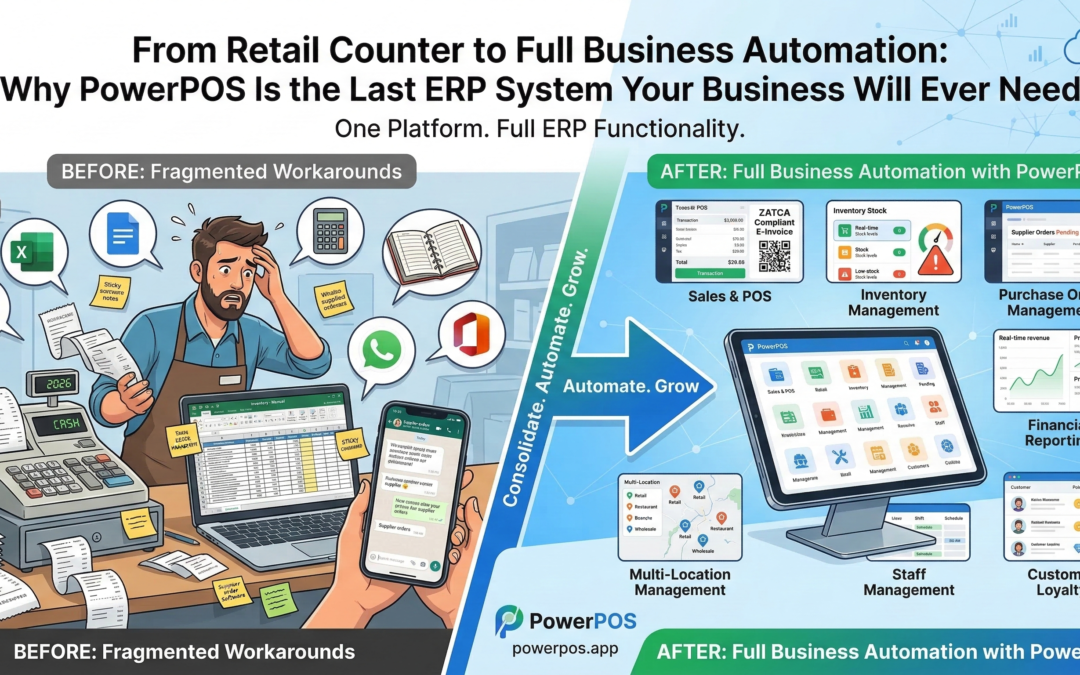
Running a business in 2026 means managing more moving parts than ever before. Customers expect faster service. Suppliers expect accurate orders. Tax authorities expect compliant records. And you — the business owner — are expected to have a clear picture of everything, in real time, while still actually running the business.
Most businesses try to solve this by layering tool on top of tool. A POS system here. A spreadsheet for inventory there. A separate accounting package. A WhatsApp group for supplier orders. A paper register for staff hours. The result is not a business system — it is a collection of disconnected workarounds that create more problems than they solve.
PowerPOS (powerpos.app) was built to replace all of it. One platform. Full ERP functionality. Built for retail stores, restaurants, wholesale distributors, and every business in between.
What Is PowerPOS?
PowerPOS is a cloud-based Point of Sale and Enterprise Resource Planning system designed for small to medium businesses that need more than a basic cash register but do not want the complexity, cost, or implementation headache of enterprise-level ERP software.
It is the operational backbone for businesses that are serious about growth — giving owners and managers a single, connected system that handles sales, inventory, purchasing, staff, reporting, and compliance, all from one dashboard.
Whether you operate a single retail outlet, a chain of restaurants, or a wholesale distribution business, PowerPOS adapts to your operation — not the other way around.
Full ERP Automation: What It Actually Means for Your Business
ERP is a term that gets thrown around a lot in business software. In practice, it simply means that all the core functions of your business — sales, inventory, purchasing, finance, staff — are connected in one system, sharing the same data in real time.
Here is what that looks like inside PowerPOS.
Sales & Point of Sale
At its core, PowerPOS is a fast, reliable point of sale system. Transactions are processed in seconds, receipts are generated automatically, and multiple payment methods are handled without friction. But unlike a standalone POS, every sale in PowerPOS instantly updates your inventory, your financial records, and your reporting — with no manual data entry required.
For retail stores, this means your stock levels are always accurate. For restaurants, this means your kitchen management and table service are connected to your billing. For wholesalers, this means every order dispatched is immediately reflected in your inventory and accounts.
Inventory Management
Inventory is where most businesses haemorrhage money without realising it. Overstocking ties up cash. Understocking loses sales. Manual stocktaking is time-consuming and error-prone. And without real-time visibility, purchasing decisions are based on guesswork.
PowerPOS eliminates all of this. Stock levels are tracked in real time across every location. Low-stock alerts notify you automatically before you run out. Reorder points can be configured to trigger purchasing actions without staff intervention. And full inventory history gives you complete visibility into stock movement, wastage, and supplier performance.
For restaurants and F&B businesses, PowerPOS tracks ingredients and raw materials alongside finished products — giving kitchen managers the visibility they need to reduce waste and control food costs.
Purchase Order Management
The purchasing side of a business is often the least automated — and the most chaotic. Supplier orders placed over the phone, delivery notes that never match the purchase order, invoices that take weeks to reconcile.
PowerPOS brings order to the entire purchasing process. Create purchase orders directly in the system, send them to suppliers, receive goods against the original order, and automatically update inventory and accounts payable — all within the same platform. Discrepancies between ordered and received quantities are flagged immediately, giving you the information you need to hold suppliers accountable.
For wholesale distributors, this is particularly powerful. Managing high volumes of SKUs across multiple suppliers requires a level of purchasing discipline that manual processes simply cannot sustain. PowerPOS makes it systematic.
Multi-Location Management
Growth creates complexity. Opening a second location should feel like an achievement, not a management nightmare. Too many businesses reach this stage only to discover that their existing systems cannot scale — leading to duplicated effort, inconsistent reporting, and blind spots in the business.
PowerPOS is built for multi-location operation from the ground up. All branches operate within a single unified system, which means you see consolidated inventory levels, sales performance, and financial data across every location simultaneously. Staff and role management works consistently across all sites. Pricing and promotions can be managed centrally or customised per location. And reporting can be viewed at branch level or rolled up to the whole business — instantly.
Customer Management & Loyalty
For retail and restaurant businesses, repeat customers are the foundation of revenue. PowerPOS includes customer profile management and loyalty functionality, allowing businesses to track purchase history, assign loyalty points, create targeted promotions, and build the kind of personalised experience that keeps customers coming back.
Understanding who your best customers are, what they buy, and how often they visit is not a luxury — it is a competitive advantage. PowerPOS makes that data accessible without needing a separate CRM system.
Staff & Shift Management
Staff costs are one of the largest expenses in any retail, hospitality, or distribution business. Managing shifts, tracking hours, and controlling access to sensitive system functions requires structure — and manual timesheets or basic scheduling apps are not sufficient.
PowerPOS includes staff management functionality that allows you to assign roles, define permission levels, track working hours, and monitor individual performance. Role-based access ensures that staff members can only access the parts of the system relevant to their function — protecting your business from internal data exposure and unauthorised discounts or overrides.
Financial Reporting & Analytics
The difference between a business that grows and one that stagnates is often not the quality of the product or the hard work of the team — it is the quality of the decisions being made at the top. And decision quality is only as good as the information available.
PowerPOS generates comprehensive financial and operational reports automatically. Daily sales summaries, weekly revenue trends, monthly profit and loss breakdowns, stock valuation reports, supplier spend analysis — all available on demand, without waiting for an accountant to compile them.
For business owners who have been making decisions based on gut feel and end-of-month spreadsheets, this is transformative. Real-time data means faster decisions, earlier identification of problems, and clearer visibility into what is actually driving profitability.
ZATCA E-Invoicing Compliance
For businesses operating in Saudi Arabia, ZATCA compliance is not optional. The Zakat, Tax and Customs Authority mandates e-invoicing for VAT-registered businesses, and non-compliance carries serious penalties.
PowerPOS has ZATCA compliance built in from the ground up — not added as an afterthought. Invoices are generated in the correct format automatically, with all required fields populated and validation handled by the system. Businesses operating in the Kingdom can process transactions with confidence, knowing that every invoice is compliant without any additional manual steps.
Why Retail Stores, Restaurants, and Wholesalers Choose PowerPOS
The needs of a retail store, a restaurant, and a wholesale distributor are different in many ways — but they share the same fundamental challenge: too many operational processes, too little time, and too much risk in doing any of them manually.
Retail store owners need fast checkout, accurate stock, and clear sales reporting. PowerPOS delivers all three, and connects them so that every transaction automatically feeds the information systems that drive purchasing and financial decisions.
Restaurant and F&B businesses need table management, kitchen coordination, ingredient tracking, and fast billing — alongside the same inventory and financial visibility that any business requires. PowerPOS handles the full front-of-house and back-of-house operation, with no gap between the dining room and the kitchen.
Wholesale distributors need purchase order discipline, bulk inventory management, customer account management, and reliable delivery tracking. PowerPOS brings all of these together in a system that scales comfortably with order volume and product range.
Cloud-Based, Always Up to Date
PowerPOS is cloud-native, which means there is no expensive hardware to maintain, no server room to manage, and no IT team required to keep the system running. Updates are deployed automatically, which means every improvement and every security patch reaches your business without any disruption to operations.
Access is available from any device with an internet connection — whether you are on the shop floor, in the back office, or checking your business performance from home at the end of the day.
For businesses with multiple locations, this is especially valuable. The same system, the same data, accessible from everywhere — simultaneously.
The Real Cost of Fragmented Systems
Every business running on disconnected tools is paying a hidden tax. Time lost reconciling data between systems. Errors that occur at the handoff between one tool and the next. Decisions delayed because the right information is buried in a spreadsheet nobody has updated. Compliance risks that emerge because invoice data lives in three different places.
The businesses that consolidate onto a single, properly integrated ERP platform consistently outperform those that do not — not because they work harder, but because they work with better information and fewer operational bottlenecks.
PowerPOS is that platform.
Getting Started Is Simpler Than You Think
One of the most common reasons businesses delay implementing proper ERP software is the fear of complexity. Long implementation timelines, expensive consultancy fees, months of staff retraining.
PowerPOS is designed to get businesses operational quickly. The platform is intuitive enough for staff to learn without extensive technical training. Implementation does not require a dedicated IT project. And the team behind PowerPOS is invested in your success after the sale — not just before it.
The Bottom Line
Your business generates a significant amount of operational data every single day. Sales transactions, stock movements, supplier invoices, staff hours, customer interactions. Right now, much of that data is either not being captured, not being connected, or not being used to drive better decisions.
PowerPOS changes that. It captures everything, connects everything, and puts the information you need in front of you — automatically, in real time, without manual effort.
From a single retail store to a multi-branch wholesale operation, PowerPOS is the ERP platform that grows with your business and works as hard as you do.
Visit powerpos.app to learn more or book a free demo.